One logistics user started with a simple question. How does EPCRA Section 311 reporting work for propane?
A few messages later, they were asking about the propane at their own site.
That shift says a lot about Tier II prep. The rules are easy to look up. The hard part is figuring out what they mean for your forklift fleet, your backup generators, or the branch that just took a new chemical delivery.
Since Scout launched, EHS teams in logistics, data centers, power generation, and manufacturing have brought it their real Tier II questions. We read through the ones that came up most. Here’s what we noticed, and what it might mean for your own prep.
Batteries Are Where the Questions Pile Up
If you’ve ever looked at a forklift and wondered whether it counts for Tier II, you’re in good company.
Batteries came up more than almost anything else. One logistics team asked how to report forklift batteries. Then they asked how to count their lithium battery amounts. A data center EHS lead worked through the sulfuric acid math for a room full of lead-acid batteries. An e-commerce team needed the weight of a single lithium-ion battery model before they could finish one site’s inventory.
“Some of the lead acid batteries we have on site are gel batteries type in the smaller equipment. They are all lead acid though. Do I need to separate the type of batteries or can I include them under the Trojan Lead Acid total?”
Batteries are tricky because the chemical sits inside a sealed product. You have to know what’s inside, how much is there, and which threshold applies. Sulfuric acid is a good example. It’s an extremely hazardous substance, so it hits the Tier II threshold at 500 pounds. Most hazardous chemicals don’t count until 10,000 pounds.
The Gallons-to-Pounds Problem
Propane and diesel show up at almost every kind of site. So do the same questions.
One team asked Scout for a diesel fuel chemical summary. Others needed a chemical’s density so they could turn gallons into pounds. Tier II thresholds are set by weight, but most sites track fuel by volume. That gap creates a lot of scratch-paper math.
Branch staff at an industrial gas supplier asked how potassium permanganate and phosphoric acid fit into their reports. In the past, a question like that turned into a support ticket or an email to corporate. Then came the wait. Now the branch can get an answer in the moment and keep moving.
Three People, One Chemical Catalog
A power generation team had three people working on chemical prep at the same time. Each of them used Scout along the way. They read SDS hazard sections, sorted out GHS classifications, and compared the physical hazards of sulfuric acid and aqueous ammonia. All of that work fed the chemical catalog they report from.
Tier II asks for hazard categories that line up with GHS. So if your SDS library is out of date, classification is where you’ll feel it. Scout can walk through a hazard section line by line and explain what it means for your report.
Every State Adds a Wrinkle
Tier II is a federal program. But states, counties, and cities add their own rules, forms, and portals.
One logistics user asked about Tier II in Fayetteville, North Carolina. A petroleum team asked how to submit through New York’s E-Plan. A packaging manufacturer wanted to know whether they needed a site map.
These are the questions that send people searching through agency websites at 4 p.m. on a Friday. Scout works from the federal and state regulations that apply to your programs. It can point you to the rule that changes your answer and show you the citation.
When the Question Becomes “What About My Site?”
Remember the propane question from the top? That pattern showed up again and again. People start with the rule. Then they turn to their own facility.
Another user asked whether a facility met its emergency planning requirements. Answering that meant checking that site’s actual Tier II data, along with the rules.
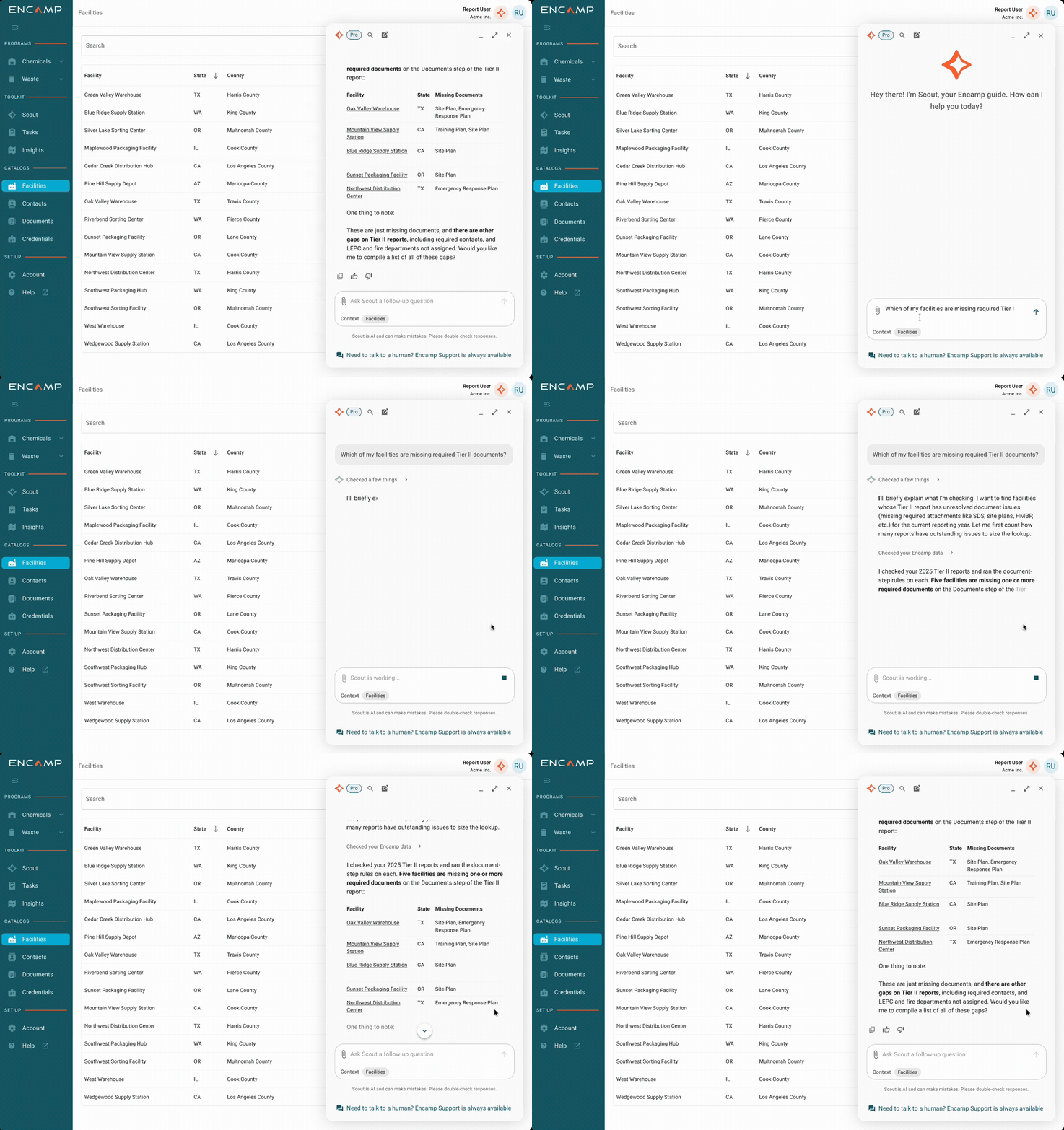
That’s where Scout Pro comes in. Scout Pro combines its access to regulations with your Encamp data to give you analysis built around your program. Teams use it to answer questions like:
- “Which of my facilities are missing Tier II documents?”
- “Who is the Tier II contact for this site?”
- “Pull RY26 Tier II status for my region as a spreadsheet.”
One of our Scout Pro customers asked, “Can you search our Tier II data and tell me if anything has propylene glycol?”
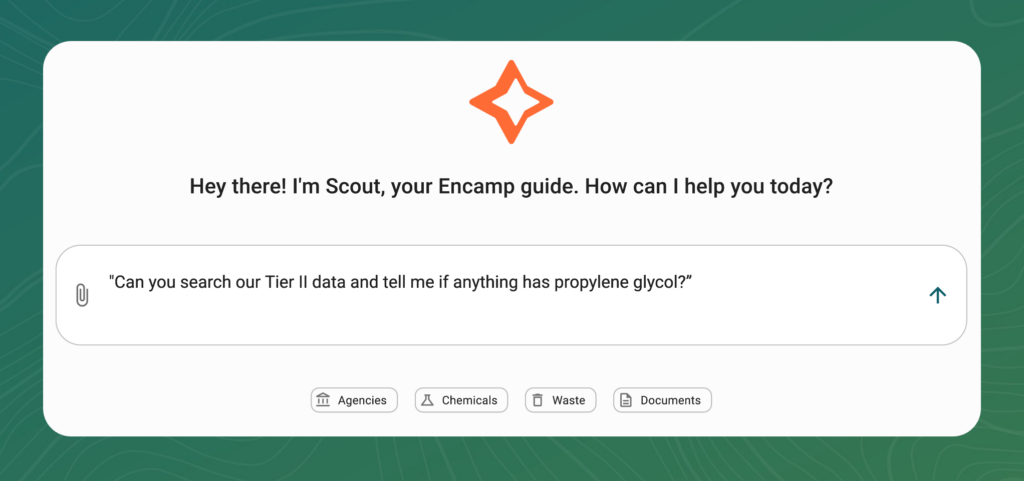
Scout searched all 600+ Tier II report lines, the live inventory, and the chemical catalog, and it checked by name and CAS number. It came back in about 5 seconds with a clear “no.” But then it went further:
- It flagged ethylene glycol as a possible mix-up and explained how the two chemicals differ.
- It explained why propylene glycol might not appear even if it’s on site.
This prompted the customer to follow up and clarify, “So no propylene glycol as an ingredient?” Scout widened the search to products and pending SDS extractions and confirmed nothing was hiding inside a mixture. What typically took hours of spreadsheet digging across a portfolio was done in minutes thanks to Scout.
What These Questions Taught Us About Tier II Prep
The federal deadline for reporting year 2026 is March 1, 2027. If your peers’ questions are any guide, three things deserve your attention early.
- Look for the chemicals hiding in your equipment. Batteries, fuel tanks, and backup power are easy to miss and slow to calculate.
- Check your SDS library before you classify. Outdated sheets lead to the wrong hazard categories, and the cleanup takes time.
- Look up state and local rules now. Portals, site maps, and extra forms are the surprises nobody wants in late February.
Want to stay on track year round? Download the Tier II Checklist.
Questions Worth Bringing to Scout
Not sure where to start? Here are a few questions your peers found helpful.
- “Do forklift batteries count toward Tier II at my facility?”
- “How do I calculate the sulfuric acid in our lead-acid batteries?”
- “Does our propane tank put this site over the Tier II threshold?”
- “How do I convert this chemical from gallons to pounds?”
- “What Tier II hazard categories apply to this chemical, based on its SDS?”
- “What does my state require on top of the federal Tier II rules?”
Ready When You Are
Scout sits beside every screen in Encamp, and it knows which screen you’re on. So, you can stay in the middle of a report and ask a question at the same time. Tier II season will always ask a lot of your team but you don’t have to work through every question alone.
Already an Encamp customer? Open Scout from any screen and ask the question that’s been sitting on your list.
New to Encamp? See how Scout and the Encamp platform help teams get every facility ready for Tier II. Book a demo.