As an EHS professional, you have questions. Lots of them.
A new chemical comes through procurement, and you need to know if it triggers reporting in three different states. A facility manager calls about a permit clause they don’t understand. An auditor asks how your program handles a specific corner of EPCRA. Leadership wants to know where your biggest chemical risk concentrations sit, and they want to know by end of day.
The answers are available. It’s just a matter of where to find them and how quickly.
Some of these answers are in the Code of Federal Regulations. Some are in state-specific rules that go above and beyond the federal baseline. Some are pulled from jurisdictional carve-outs that only apply to a single city. And many of these answers are in your own facility data, chemical inventories, and historical filings inside Encamp.
Getting to a defensible answer means pulling threads across all of those sources. That’s hours of work for a question that, in a perfect world, you could just ask out loud.
That’s the problem we built Scout to solve.
Introducing Scout
Scout is the AI advisor built into the Encamp Compliance Platform. It gives you a way to ask the questions you’ve always had (about the regulations, about your facilities, about the chemicals you manage) and get expert answers grounded in real sources.
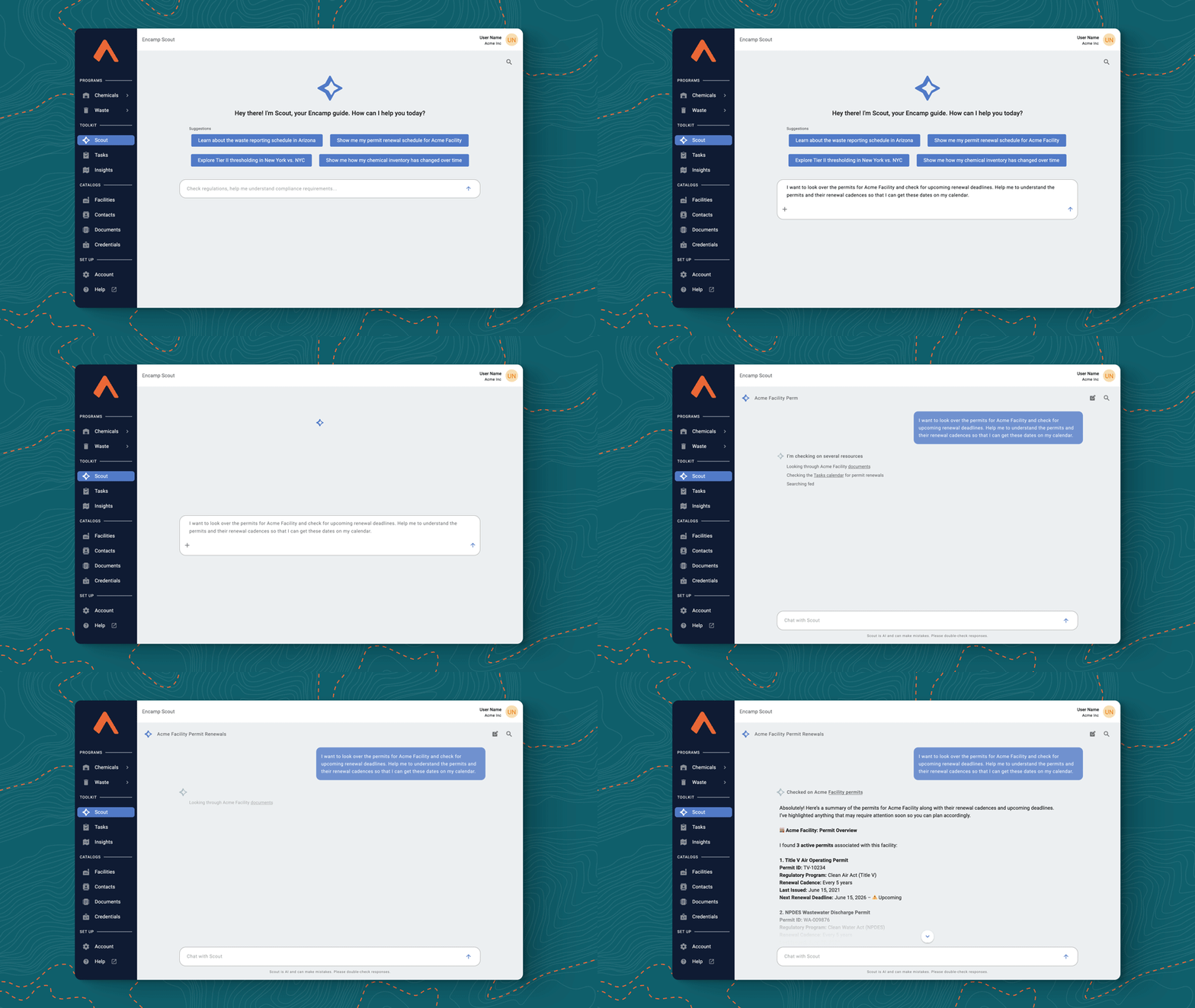
Here’s what makes Scout different from a general-purpose AI tool:
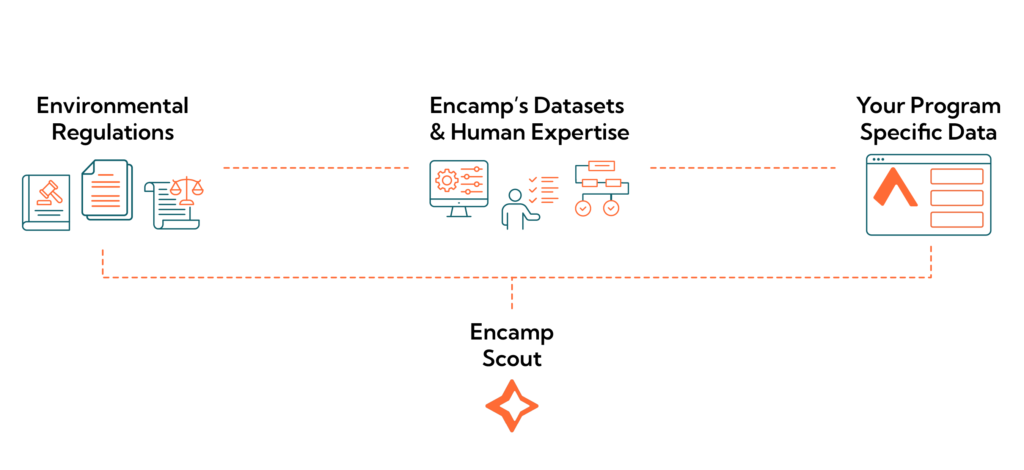
Scout has direct access to the regulations relevant to your programs. The Code of Federal Regulations. State and local rules. Agency guidance. The Encamp knowledge base. All support articles. And, critically, your own Encamp data, including facility profiles, chemical and waste data, and historical filings.
When you ask Scout a question, it doesn’t guess. It researches, pulls from the right sources, weighs them, and gives you a citation trail you can follow back to the original text.
A Question a General AI Tool Would Get Wrong
Here’s the kind of question Scout was built for:
“How do reporting thresholds differ between the state of New York and New York City?”
Ask a general-purpose LLM that question and you’ll probably get a confident, plausible-sounding answer. You’ll also likely get the wrong one.
Most states adopt the federal Tier II thresholds and call it a day. New York City does not. The city has its own thresholding rules that go beyond the federal requirements, and they’re structured differently, often by chemical category rather than by individual CAS number. Explosives, for example, have a very low threshold in New York City. If you don’t know that, you’ll under-report. If you under-report, you have a compliance problem.
When you ask Scout that question, here’s what happens:
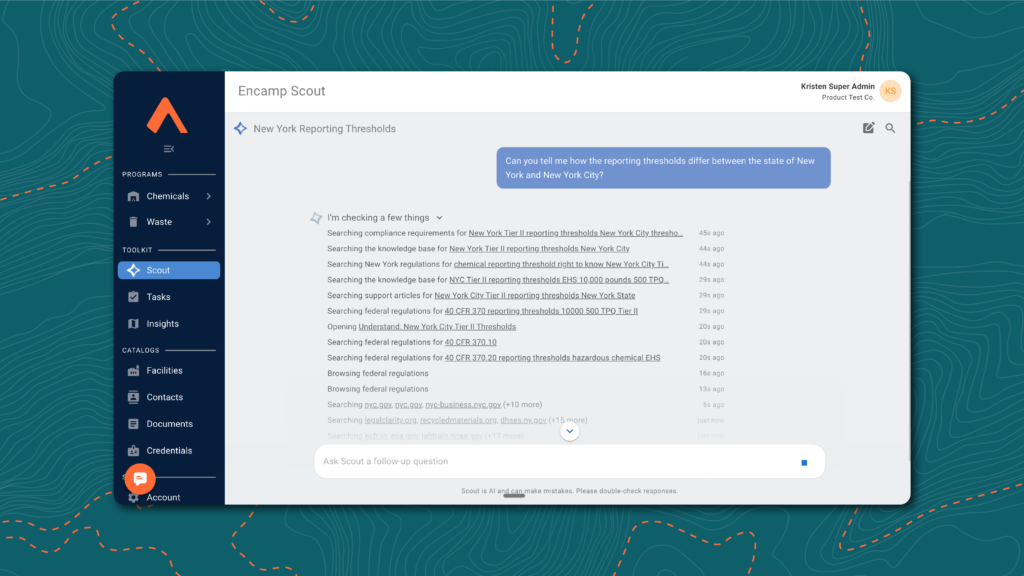
Scout searches the Code of Federal Regulations. It searches the Encamp knowledge base and our support articles. It searches the Encamp compliance engine, the software that already tracks jurisdiction-specific thresholds and applicability rules. It checks government sources, including nyc.gov and EPA websites. Then it summarizes the guidance and gives you citations for every claim it makes.
You get an answer that reflects how the rule actually works in that jurisdiction, not a generic federal summary. And you get the receipts to back it up.
Bespoke Analysis Across Your Own Data
The regulations are only half the picture. The other half is what’s actually happening at your facilities.
Scout can answer questions about your Encamp data too. And it can combine its access to the regulations with your data to do real analysis.
Say you want a reference table of your facilities in California. Ask Scout.
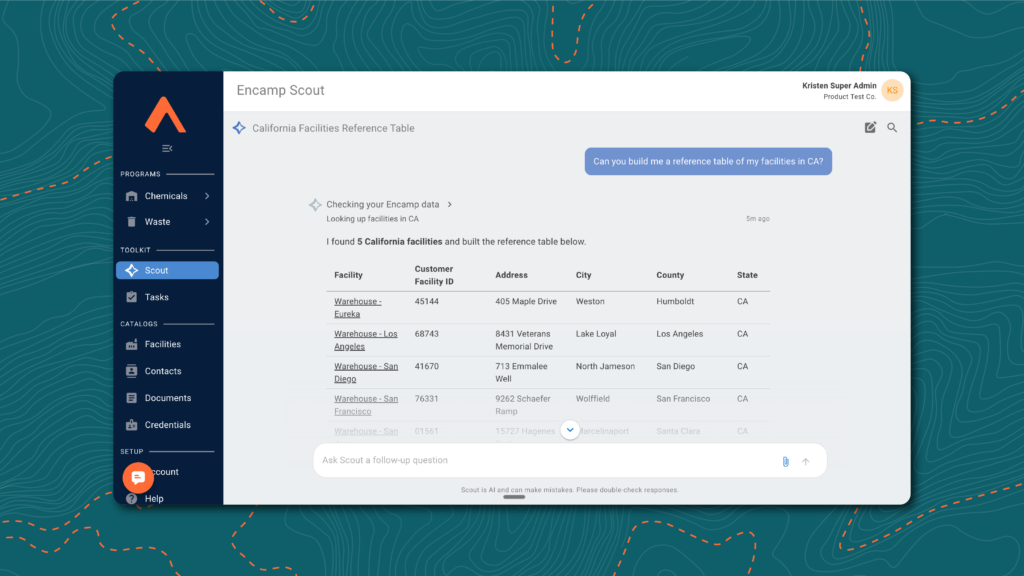
It builds the table, links each facility directly back to its profile in Encamp, and gives you a map. From there, ask for the chemical inventory across those facilities, organized by risk. Scout flags the highest-risk substances first — maybe 73,000 pounds of lead-acid batteries across a handful of sites, a gasoline additive that’s banned in several states, and anhydrous ammonia in another location.
Then take it one step further. Ask Scout for an EHS one-pager on that gasoline additive. Scout pulls together the regulatory risks, the occupational exposure limits from OSHA, the special handling requirements, engineering controls, PPE, storage and segregation guidance, spill and release procedures, and emergency response steps. It shows you a map of where the substance lives across your facilities, so you know exactly where the exposure is concentrated.
And here’s the part that matters most: Scout will flag inconsistencies as it works. If the SDS for a chemical doesn’t match the CAS number in your chemical catalog, even if that mismatch has been sitting in your data for five years, Scout surfaces it as something worth correcting. The data you inherited gets a fresh set of eyes. The problems you didn’t know you had become problems you can fix.
Why This Matters for Your Program
Environmental teams spend an enormous amount of time being the human bridge between regulations and reality. You’re the person who knows that a state rule applies on top of the federal one. You’re the person who remembers that one facility uses a chemical that requires a different threshold calculation. You’re the person who has to translate the CFR into something a facility manager can act on.
That knowledge is valuable. But it shouldn’t only live in your head, and you shouldn’t have to be the bottleneck every time a question comes up.
Scout gives your team a way to ask hard questions and get defensible answers without waiting on you, without guessing, and without hoping the LLM they pulled up in a browser tab got it right.
It’s expert guidance, on demand, grounded in the regulations and your own environmental program.
What Scout Brings to Your Environmental Compliance Program
Scout is the intelligence layer built into the Encamp Compliance Platform. The chat interface is one way you interact with it, but Scout also reads the documents you upload, surfaces deadlines as they approach, and works across your program to turn compliance data into compliance action.
Scout combines Encamp’s datasets and human expertise, years of compliance knowledge, paired with the power of frontier AI models, to give you analysis you can trust.
See Scout in Action
Scout is part of the Encamp Compliance Platform — and included with any Encamp product at no extra cost. If you want to understand what’s included and where Scout Pro picks up from there, start here. Or if you’re ready to see it in action, we’d love to show you.