Family Dollar | Encamp
8,000 Stores. One Waste Stream Nobody Fully Owns.
Every Family Dollar location generates hazardous waste. Aerosols, batteries, electronics, cleaning chemicals, and damaged or recalled products all have to leave the store the right way, not just any way. A landfill isn’t a disposal option. It’s a $2.72 million lesson the industry has already learned once.
Encamp is the guided compliance platform built for exactly this kind of scale. We combine expert support with purpose-built software so your team can prove chain of custody at every store, in every state, without adding headcount.
Encamp Scout — AI built for environmental compliance.
Scout monitors your regulatory landscape so you never get caught off guard by a new state disposal rule, a generator status change, or a manifest requirement that nobody flagged. It’s the intelligence layer that keeps your program proactive across thousands of locations, not reactive after an inspection.
How Encamp Helps
Liability that stops at the loading dock
Once hazardous waste leaves a store, your company is still on the hook for where it ends up. That’s true whether it’s an expired aerosol can, a damaged battery display, or a pallet of recalled cleaning product waiting behind a distribution center. Under RCRA, generators carry responsibility from the moment waste is created to the moment it’s properly disposed of. That’s the cradle-to-grave standard, and it doesn’t stop being true just because a store manager or a third-party hauler handled the last step.
Encamp gives you the documentation to prove your waste went where it was supposed to go, at every location, every time. That means manifests you can actually produce on request, generator status that’s accurate instead of assumed, and a clear record if a regulator or a plaintiff’s attorney ever asks the question directly: where did this waste end up?
Chain of custody you can actually see
Manifests, disposal records, and generator status shouldn’t live in a filing cabinet at each store, or in a folder on one compliance manager’s laptop. When that’s how it works, chain of custody is really just chain of hope. Nobody finds the gap until an inspector does.
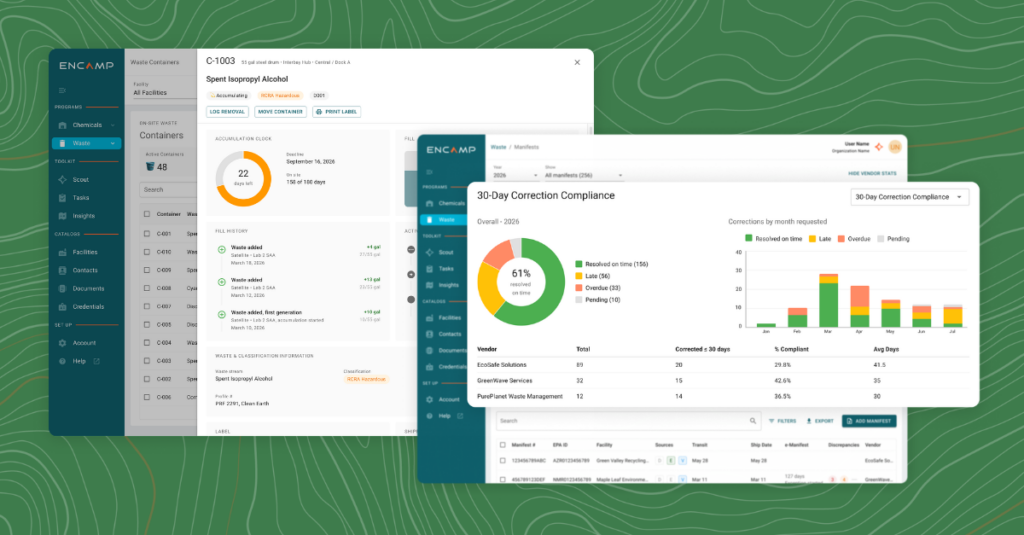
Encamp centralizes chain of custody across your entire footprint, from store to distribution center to final disposal. Your team can answer “where did that waste go, and can you prove it” in minutes, not weeks, and not with a scramble across regional folders. That visibility also means you can catch a problem, a hauler that’s cutting corners, a store that’s mislabeling waste, a DC that’s missing a manifest, before it becomes a violation instead of after.

One system, every state
Disposal rules change by state, and sometimes by county. A cleaning product that’s non-hazardous in one state can trigger generator obligations in another. A store in California operates under different thresholds than a store in Texas, and both are part of the same corporate liability.
Encamp tracks those differences for you and flags what’s changing before it becomes a violation, so your team can stay ahead of dozens of overlapping rule sets instead of memorizing them one by one. As you open new stores or shift distribution, the system scales with you. Growth doesn’t mean starting your compliance research over in every new jurisdiction.
Why does it matter?
Retail hazardous waste violations aren’t hypothetical. A sister discount retailer paid $2.72 million after a statewide investigation found stores routinely sending toxic, corrosive, and ignitable waste to landfills instead of permitted disposal facilities. The problem wasn’t bad intent. It was a lack of visibility into what was happening at the store level, multiplied across hundreds of locations.
Family Dollar’s scale is the strength of the business. It’s also the exact condition that makes hazardous waste compliance hard to manage with spreadsheets, tribal processes, and manual tracking. Encamp gives your team a system built for that scale, so growth doesn’t come with growing liability.
Resources
The RCRA Guide
Discount retailers manage hazardous waste at a scale most industries never see. This guide breaks down federal thresholds, state-by-state disposal rules, and generator status changes, and shows where the risk actually hides for retailers with thousands of stores.
The RCRA Checklist
A practical, store-manager-friendly reference for what counts as hazardous waste, how it has to be stored, and how it has to leave the building. Built for teams who need consistency across every location, not just the ones corporate visits.
System of Record or System of Action?
A quick self-assessment to find out if your current compliance program actually prevents violations, or just documents them after the fact.