Costco | Encamp
Every Warehouse Has Its Own Rules. Encamp Helps You Keep Up With All of Them.
With warehouses across the country, Costco faces a different set of hazardous materials and waste reporting rules in nearly every state and county where you operate. Every location handles hazardous materials. Every location answers to a local agency. And every location needs to stay current, year after year, without gaps.
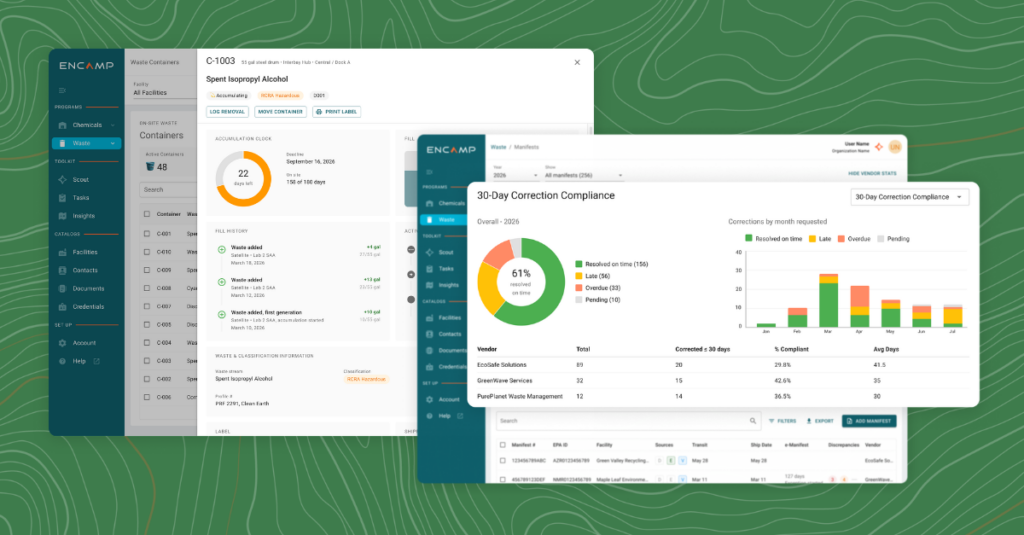
Encamp gives your EHS team one system to manage it all, from hazardous materials inventory to annual certification, so nothing slips through and no one is scrambling at the deadline.
Encamp Scout — AI built for environmental compliance.
Scout watches your regulatory landscape so nothing catches your team off guard, whether it is a generator status change, an upcoming filing deadline, or a local rule that just updated. Ask Scout what is coming due across your locations, and get a straight answer, pulled from your real data.
How Encamp Helps
Built for local nuance
No two warehouses report to the same set of rules. A location in one state answers to a state agency with its own thresholds and forms. A location in another state answers to a county or fire department with its own site plan requirements and its own filing calendar. Multiply that across hundreds of warehouses, and the rulebook is not one document. It is hundreds of them, each changing on its own schedule.
Encamp keeps up with all of it. When a local agency updates a contact requirement, changes a threshold, or adds a new form, that update shows up in your account automatically. Your team does not have to monitor hundreds of local agencies by hand or find out about a change after a deadline has already passed. Encamp tracks the nuance so your hazardous materials plans stay accurate everywhere you operate, not just in the states someone happened to check most recently.
Catch errors before they become fines
A manifest error rarely looks like a big problem in the moment. A transporter ID that does not match, an EPA ID that was typed wrong, a chemical quantity that jumped without an explanation. On its own, each one seems small. But the generator is always the one held liable, regardless of who made the mistake, and regulators are reviewing manifest data more closely and more often than they used to.
Encamp checks every manifest against your facility and vendor data before it becomes a problem. If a transporter ID looks off, if an EPA ID is missing, or if a waste quantity does not line up with your history, Encamp flags it right away, while there is still time to fix it. That means fewer corrected manifests, fewer calls from a regulator asking questions, and fewer surprises showing up in an audit months after the fact.
One login, not a dozen
Right now, keeping hundreds of warehouses compliant probably means logging into a different portal for every state, every county, and every agency that has a claim on your data. Every one of those systems wants your facility information updated separately, on its own schedule, in its own format. That is a lot of logins for one team to manage, and every extra login is another place something can fall through the cracks.
Encamp gives you one place to update your data once. From there, Encamp handles the filing across every state and local portal that applies to your locations, so your team is not re-entering the same facility information five different ways. Add a new warehouse, and Encamp maps out exactly what that location needs to report and where. Your team spends less time managing systems and more time managing actual compliance.
Why does it matter? Stay audit ready.
Environmental compliance often gets treated as a cost center, and budget pressure is real. But a hazardous waste finding does not stay small. It can trigger fines, escalating scrutiny, and years of follow-up review, and the generator is always the one on the hook, even when a vendor or a transporter made the mistake.
Digital audits are also catching more than they used to. Regulators are reviewing manifests more closely and more often, and errors that once took years to surface are now showing up in the data almost immediately.
Encamp is not another system to add to your workload. It is a partner that protects what you have already built, so your team can focus on the work that actually reduces risk.
Resources
The RCRA Guide
For a company with pharmacy operations in every warehouse, RCRA isn’t abstract — it’s a daily operational reality. Pharmaceutical waste classification, proper disposal pathways, generator status across 130+ California locations — each one a compliance obligation with real enforcement behind it. This guide covers what federal hazardous waste regulations require in 2026, where high-volume retailers with complex waste streams tend to run into trouble, and how to build a process that scales across every facility without relying on tribal knowledge or manual tracking.

The Tier II Guide
When you store hazardous chemicals at scale — refrigerants, cleaning agents, propane, fuels — across more than 130 California warehouses, Tier II isn’t a once-a-year checkbox. It’s a program that has to run correctly at every facility, every reporting cycle. This guide covers what EPCRA Section 312 requires in 2026, how threshold determinations work across multiple chemical types and storage configurations, and where multi-site retailers tend to accumulate risk without realizing it.

System of Record or System of Action? A Self-Assessment for EHS Leaders
Costco’s warehouses generate a lot of compliance data: manifests, inventories, filings, and facility records across hundreds of locations. This self-assessment helps your team figure out whether that data is just being stored, or whether it is actually being used to catch risk before it becomes a fine. A quick, honest gut check on where your program really stands today, and where it has room to grow.
Meet Your Team
Will Locke
Dillon Virva
Josh Moyers
More Resources