Ask most EHS teams how their hazardous waste program is doing, and they will point to a tracking system. It logs generation, storage, and shipment. It looks complete.
But under RCRA, “complete” is a high bar. The law follows hazardous waste from the moment it is generated to its final disposal, and the generator carries that responsibility the whole way. It does not transfer when a hauler signs for a load. It does not end when the waste reaches a disposal facility. If a disposal site is later named in a cleanup action, the generators who sent waste there can be pulled back in, sometimes decades later.
That is what makes waste different from almost anything else an EHS team manages. The liability is not a moment. It is a chain, and it only takes one weak link to expose the whole thing.
The Data Lives in Pieces. The Liability Does Not.
Here is where most programs run into trouble. Waste data rarely lives in one place. A tracking module covers part of the record. Vendor portals account for another part, often a different one for each hauler or disposal partner (assuming one exists at all). The federal e-Manifest system carries its own share, and a consultant’s inbox or a hand-maintained spreadsheet usually fills in the rest.
Each of these holds a piece of the record. None of them holds the whole thing.
That would be a manageable inconvenience if the liability were as fragmented as the data. It is not. RCRA does not grade on a curve for effort. It expects a generator to be able to account for the entire chain of custody, not just the parts that happen to live in the system they check most often.
Most systems track waste well while it is still on site. The moment it leaves, visibility drops. The waste moves to a transporter, then a facility, then into records the generator does not control and often cannot see. That handoff, where the waste leaves your hands but never leaves your liability, is the exact stretch most programs are least equipped to watch.
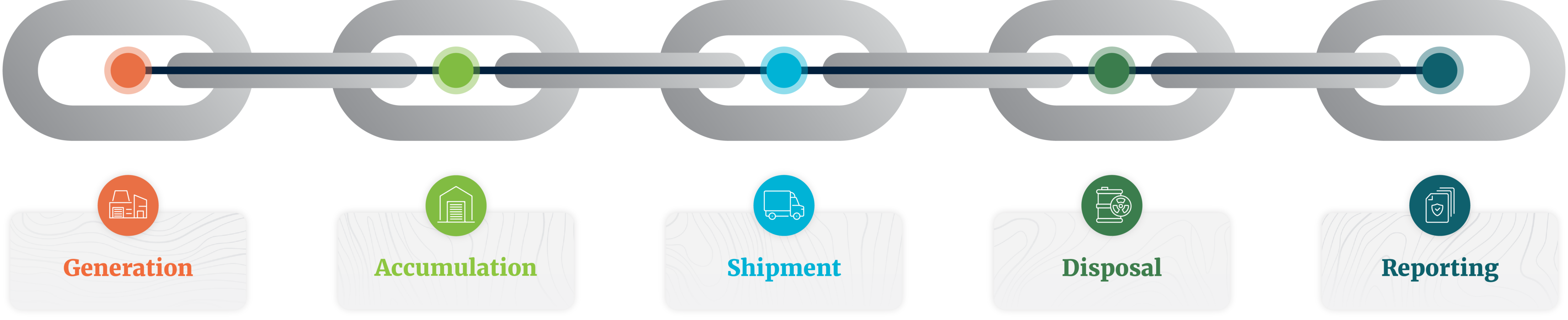
Six Places to Look for the Break
Walking the chain of custody end to end tends to surface the same six weak points, regardless of company size or industry.
No single view of the data. If no one can answer “what waste do we have, where is it, and what have we shipped” with confidence, that is not a reporting problem. It is a visibility problem, and it is the foundation every other issue on this list is built on.
Manifest discrepancies that go uncaught. What a vendor reports and what actually happened do not always match. Without something reconciling the two, errors sit quietly until an agency finds them during an inspection.
Vendor-controlled data. A generator can outsource the handling of waste. It cannot outsource the liability for it. When a vendor leaves a field blank or files late, the violation lands on the generator’s record, not the vendor’s.
Generator status drift. Status depends on how much waste a facility actually generates. When that data is scattered across systems, status can drift in either direction, and both directions carry a cost.
Reports and fees that slip. Periodic reports, status updates, and fee payments all run on their own schedules. When tracking them is a manual, split responsibility, something eventually falls through, and a missed deadline becomes a penalty that had nothing to do with how the waste itself was handled.
No audit-ready record. This is where the chain closes, or does not. A connected record from the point of generation forward is what lets a team stand in front of an inspector and tell the complete story. Without it, that final link is missing, and audit readiness becomes a scramble instead of a standing fact.
What to Do With This
None of these six breaks come from bad intent or sloppy work. They come from the gaps between disconnected systems, where no single source of truth owns the whole record.
A useful exercise for any EHS team: pick one facility and try to trace a single waste stream from generation through final disposal using only the systems currently in place. Note every place you have to leave one system, check another, or ask someone for a spreadsheet. Each of those handoffs is a candidate for where your program’s real exposure lives, not the parts you can already see clearly.
Closing the visibility gap does not require replacing every tool overnight. It starts with knowing exactly where the chain breaks today, because that is the same map an inspector will eventually walk, whether your team walks it first or not.
This article originally appeared on the NAEM Blog on August 5, 2026.